

Tonight I’m making a ham and bean soup. The ham is from one of our hogs and I can’t wait to enjoy some smoky comfort food. Cooking with food we raise is one of the best parts of owning a farm.
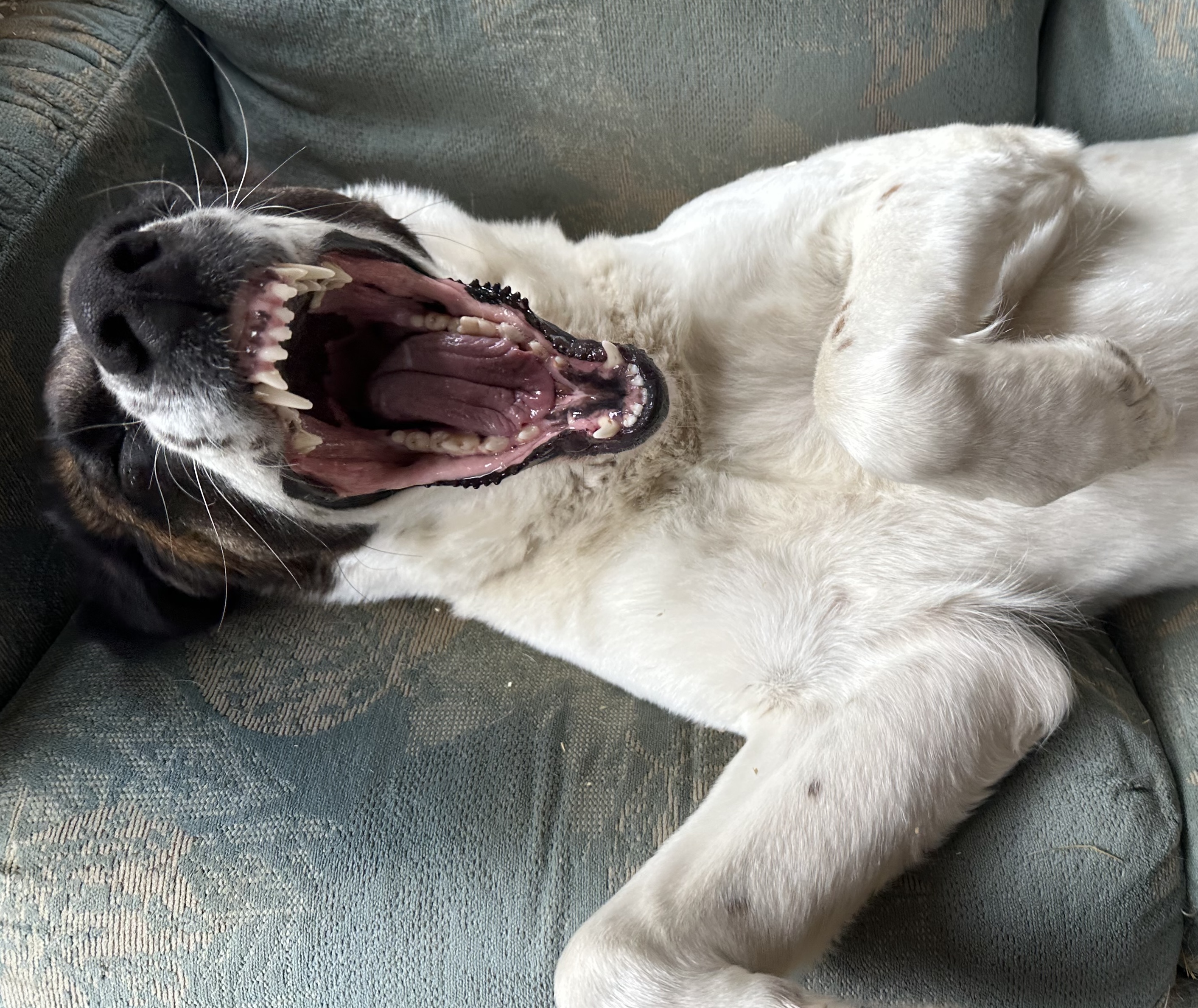
The radio is on in the background. Voices talking about things that feel very distant. The cat is blatting at me because her bowl is only half full, which she considers a full-blown crisis. The dogs are pacing by the door. Moxie is letting out a low, irritated growl. Something outside demands her attention and I’m keeping her from it with my damned opposable thumbs.
I catch myself thinking, I hope it’s not a fox stealing my layers again. Hatching chicks to egg layers is a seven month process. I let her out in hopes she stops whatever it is that’s causing our ladies to fret.
It’s ordinary, run-of-the-mill chores around here, and it’s a good night. Yet, my brain won’t fully settle because somewhere underneath all of this ordinary is a constant, low-level awareness that something could go wrong at any given moment. Not catastrophically, thank God. Not dramatically, usually. But something.
A few years back, about this time, we were cleaning out around the cows’ hay ring. Everything was heavy: the ground, the air, the mud. The mud was awful, as it usually is come April.
We were using our old Belarus tractor. A 1990, 20-horsepower machine. Not pretty, but it worked. Until it didn’t.
We hit a rock. A big one, buried under about a foot of mud and cow manure. The tractor sank hard at the wrong angle and that was just enough to snap the axle.
I remember that day well. We had to call Larry, our mechanic friend down the road, to pull us out. He needed all of his equipment to do it. That’s how stuck we were. We stopped when it was too dark and had to pick up where we left off the next day. I wasn’t panicked exactly, but something close. I had questions and no answers. How do we finish this now? More importantly, what will this cost? How long will the tractor be down?

We’d share pictures of the whole event—but we lost that phone in the mud abyss, too. We’re not kidding. We never found it.
Sort of like finding parts for a 1990 Belarus. Even if we could have found a suitable axle, we would have struggled to find someone who had the time and energy to replace the broken one with a used one. We tried for days, and days turned into weeks, weeks turned into months.
The tractor being down wasn’t just the tractor being down. It meant time, money, and everything backing up behind it. The paddocks were gross in just a few days. We ended up having to bite the bullet and buy a new tractor, but it took us six months to secure USDA funding for it. It was one delay after another. In the meantime, we were trying to farm by hand and juggle what we could.
The cows still needed to eat. They always do.

This meant dragging heavy alfalfa haylage on tarps and pitching it in over the fence with pitchforks, daily. Sometimes twice a day. It meant losing boots in the mud. It meant sore muscles, strains, backaches and, for me, a lot of actual tears.
The crying is part of it too. Over losing an animal. Over the weather. Over debt. Over a broken tractor. Over slipping on ice when you’re already exhausted. Believe it or not, poor quality hay can cause tears. Sometimes it only takes one more thing.

I once cried on and off for the better part of a day because our high tunnel flooded. In retrospect, it wasn’t the tunnel. It was everything behind it.
Farming is constant awareness of what can go wrong. Equipment breaks when we need it most, and the margin of error is so very, very small. There’s research on this, too. Farming is consistently linked to higher levels of stress, anxiety, and depression. Some studies estimate farmer suicide rates are two to five times higher than the national average (Farm State of Mind, n.d.). It’s chronic stress. And when you farm as a couple, as we do, that brings its own set of challenges.

It makes perfect sense, because it’s not one thing, it’s everything, all at once, day in and day out.
I know I shouldn’t complain. We have so much to be thankful for. Truly. We built this place. We get to do this. There is a lot of good here, more than I probably say out loud. But two things can exist at the same time. You can be grateful for the life you’ve built and still feel the weight of it.
Today, I’m making soup because the buckling I was supposed to bring home from Southern Maine didn’t come home. Again, it was something small. The breeder messaged me as I was about to leave to tell me she’s battling a wicked case of ear mites in her herd. That’s a biosecurity issue for our USDA organic farm. We can’t go get him.
Those little bugs were enough to shift our entire day. Plans changed. Schedules moved. We adjust. We also feel badly for the farm who sold us the goat, because now she has to treat her whole herd, and it’s an unexpected expense on her end as well. Little buckling Benny will have to be picked up another day. (Perhaps on a day when I’m already overwhelmed.)
From the outside, I think all of this probably sounds petty or minor. And in some ways, it is. On the other hand, farming is built on timing. The slightest of disruptions ripple outward, and one thing leads to another. We don’t always see the impact right away, but it’s there.

Then there’s the part people really don’t talk about: what happens when farmers don’t feel well. There’s no clean way to step back. No real “calling out.” If you’re sick, the work is still there, waiting.
So you move through it differently. Slower, maybe. More aware of your limits, but not always able to honor them. Then, if hired help doesn’t show up, you absorb that too. The animals don’t know you’re tired, or overwhelmed, or not feeling like yourself. They just need what they need.

Over time, something has shifted in how I think. I run scenarios constantly, without even realizing it. If this breaks, what’s the backup? If that fails, what’s next? If something feels off, how bad could it be?
That last one sticks with me the most.
When you live in a system where small problems can become big ones quickly, your brain learns to pay attention, sometimes a little too well and then the anxiety sets in.
But, thankfully, there’s another side to it.
The soup is still simmering. The dog made it outside. The cat is finally satisfied. The animals are fed. The fences are holding.
Nothing went wrong today. On a farm, that’s something you notice.
Farming isn’t peaceful in the way people imagine. It’s not predictable. It’s not controlled. It’s not safe from disruption. But IT IS steady, because we’ve learned how to keep going when things go wrong.
Tomorrow, something will need fixing. Something will shift. Something won’t go according to plan.
And we’ll figure it out.
We always do.
Make a one-time donation
Make a monthly donation
Make a yearly donation
Choose an amount
Or enter a custom amount
Your contribution is appreciated.
Your contribution is appreciated.
Your contribution is appreciated.
Source: Farm State of Mind. (n.d.). American Farm Bureau Federation. Retrieved March 27, 2026, from https://www.fb.org/initiative/farm-state-of-mind



Leave a Reply