
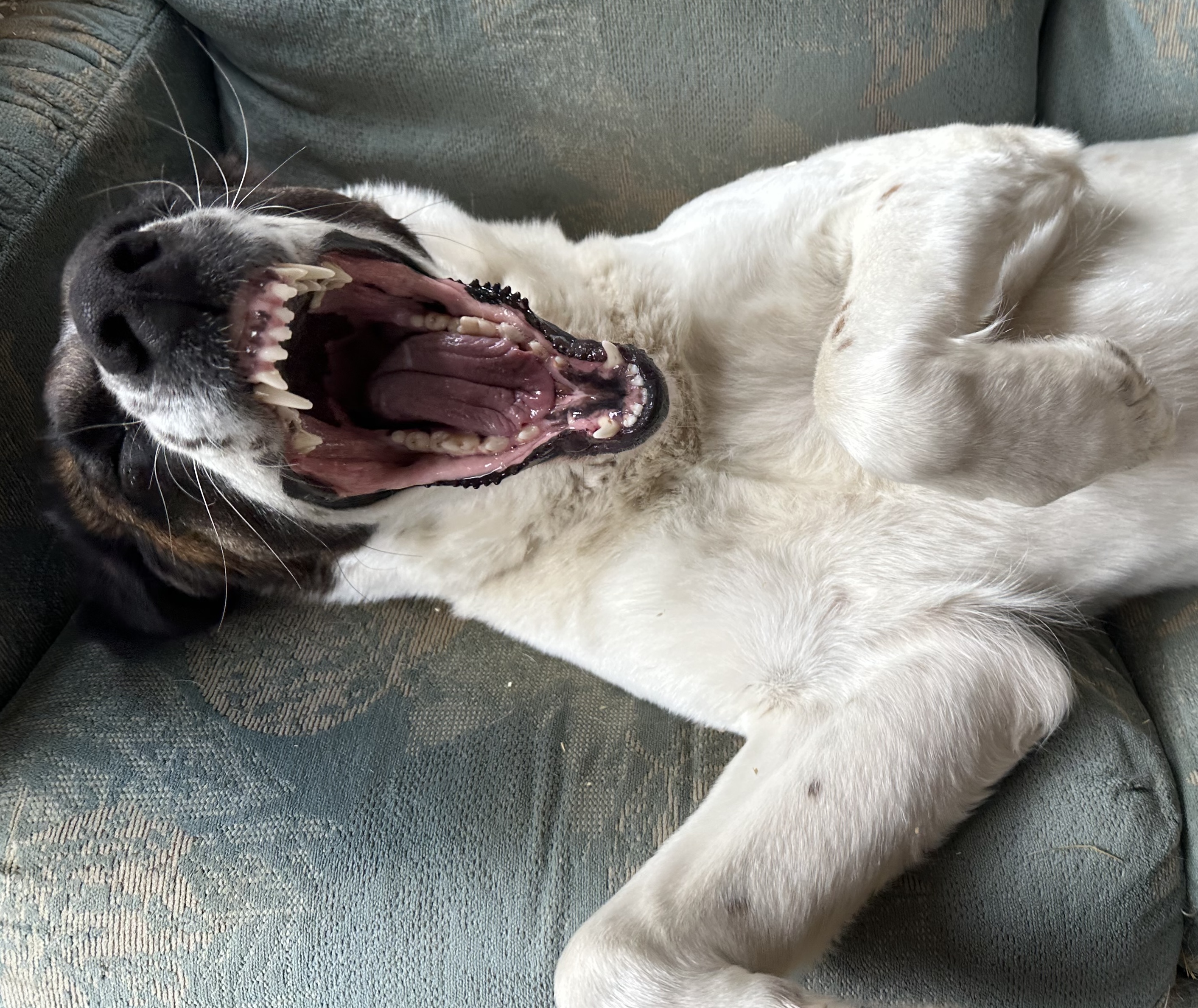
If you’re trying to decide between a Maremma, Great Pyrenees, or Alabai as a livestock guardian dog, here’s the short answer:
– Great Pyrenees are warning machines. They require steadiness and a fair, firm hand.
– Maremmas tend to be balanced and observant and require similar training.
– Alabai are the most intense and best suited for experienced handlers with large tracts of land.
But the reality is that it depends entirely on your farm, your animals, and your setup.We brought home a Maremma (mah-REM-uh) last month, and I’ll be honest, I wasn’t entirely sure what to expect.
We have lots of experience with the Alabai (ah-lah-BYE) breed. My best friend Ronda from Water’s Edge Farm in Princeton runs Great Pyrenees (GREAT peer-uh-NEEZ). Somewhere in my head, I think I assumed all fluffy livestock guardian dogs were more or less similar. Just big, white, protective, and good with animals.
They’re not. Not even close.
What Is a Livestock Guardian Dog?
If you’ve never had one, livestock guardian dogs (LGDs) are a different category altogether from your typical farm dog. There are a variety of breeds. Today, we’ll focus on just three.
They aren’t herders. In fact, they aren’t pets in the traditional sense. Honestly, they’re not a great fit for most suburban setups either. I wrote more about that here.
They’re definitely not super interested in doing tricks for anyone. (Although, we have taught Moxie a few that she performs when she wants attention.)
They’re mostly bred to live with livestock including goats, sheep, and chickens. Their number #1 mission in life is to protect the farm from predators. They have a presence more so than chasing things down, although they do that too. They’re aware and very willing to escalate if something threatens “their” animals.
Think of it as roughly 10% training commands and 90% pure instinct.
Also know that their instinct shows up very differently depending on the breed.
Our Experience with an Alabai
Our Alabai is…a lot of dog. Full stop.

There’s really no other way to put it.
Alabai (Central Asian Shepherds) are powerful, independent, and very serious about everything. When they decide something is a threat, there’s zero hesitation. There’s no second-guessing, no looking back for reassurance.
For us, this is a good thing. Pre-Moxie we lost a ton of chickens to predation. Post-Moxie, hardly any. (We had an owl take one and recently a sly fox who met his demise on Rte. 214 not too long ago). Other than that, predators have been largely a thing of the past.
For others, this quick to judge attitude is not a good thing.
With an alabai, you need to be ready for a dog that doesn’t:
- back down easily
- ask permission
- or care much about your opinion.
Here’s a picture of Moxie refusing to come in. Apparently, something was threatening her animals earlier in the day and she wasn’t satisfied the threat was adequately eliminated. As a result, she wanted to wait it out. We begged her to come in. We tried to move her and she was not having it.

She has a nightly ritual. Rain, snow, sleet, or wind, she’ll run the perimeter of our farm, checking on all of the livestock. She won’t come back to the house until she’s damned good and ready. We can see her from the second story of our farm house with binoculars. Sometimes, when the coyotes are moving, she posts up at the edge of the blueberry field. She’ll stay on edge, watching, springing to her feet at every crunch in the woods for hours.
They’re not soft. They’re not subtle. They’re also not forgiving of mistakes (yours or anyone else’s for that matter).
In the right situation, they’re incredible. In the wrong one, they can be overwhelming.
Great Pyrenees: What I See from Water’s Edge Farm
Water’s Edge Farm’s Great Pyrenees are guardians. Still protective. Still fully capable of doing the job. But there’s more personality to them.

They tend to be very approachable. More people-friendly and adaptable to different farm setups. I credit the farm owners with making their dogs so socialized. So, there’s that aspect that can’t be overlooked.
I’m sure they would tell you that they bark all night as well (because that’s their job), and they’ll defend their animals to the hilt. BUT, they do it with more warning, more presence, and a little less immediate intensity than something like an Alabai.

They feel…more adaptable to me. Which is probably why so many people love them.
Here’s a great shot of Denali on the literal Water’s Edge.

Enter the Maremma
And then there’s the Maremma.
Stella is not what I expected.
I think I had this idea in my head that she would be more like the Great Pyrenees. After all, she’s got similar fluffy fur. I expected calm, reserved, quietly watching everything like some kind of thoughtful farm philosopher.
She’s not that. Ha!
She jumps on everyone. Fully committed. No hesitation. Zero concern for personal space. Yet—at the same time—there’s something else going on.

She is observant. She does watch everything. But it’s layered under this big, physical, very present personality that’s hard to miss.
It’s a very different energy than the Alabai. Moxie is reserved in her approach.
With Stella, work is less deliberate. It’s less intense in a confrontational way.
But definitely not subtle.

She’s not nearly as “easygoing” as I think people assume when they hear the word Maremma.
At least…not this particular one.

I’m realizing pretty quickly that “gentle” doesn’t mean “low energy.” It just means they express it differently.
So…Which Livestock Guardian Dog Is “Best”?
That’s the question everyone wants answered.
The truth is it depends entirely on your farm, your animals, and your tolerance for intensity.
If you need a dog that will stand its ground no matter what, an Alabai might be exactly right. But, you need to be prepared to invest a good amount of time in training early on. These dogs are not for everyone.
If you want something more approachable and maybe something that can bridge the gap between working dog and farm companion, I think a Great Pyrenees often fits well. Again, early training is absolutely key and you have to remember that they are decision-makers. Too hard of a hand and you can ruin a good dog in the making.
If you’re looking for something in between…still independent, still capable, but expressing it in a different, sometimes more nuanced way, a Maremma might be worth considering. Don’t forget early training matters here, too.
Where These Breeds Come From (And Why It Matters.)
The more time I spend with these dogs, the more I realize they differ so much in personality. Perhaps it’s because they come from entirely different worlds.
Those origins show up in how they behave, learn and grow as LGDs.
Maremma (Italy)
Maremmas come from central Italy. They hail from regions like Tuscany and Abruzzo where they were used to guard sheep in more settled, agricultural landscapes.
There were farms, villages, people nearby. That seems to show up in them. So, they weren’t technically operating in total isolation. They love people.
They’re still independent, still very much working dogs but there’s an awareness there. I would describe it as a kind of adaptability that makes them easier to fit into a farm that isn’t completely remote.
Even if mine expresses that with full-body enthusiasm.

Great Pyrenees (France/Spain)
Great Pyrenees come from the Pyrenees Mountains between France and Spain.
They were bred to guard flocks in rugged terrain, often working at a distance from shepherds but still within a structured system.
They needed to think independently, but also coexist with people, other dogs, and movement around them.
That balance shows up in how they work.

They’re protective, but they tend to lead with warning—barking, presence, letting something know it’s not welcome before escalating further.
They’re measured and great with all aspects of farm life.
Alabai / Central Asian Shepherd (Central Asia)
Alabai come from a much harsher environment..Central Asia, including places like Kazakhstan and Turkmenistan.
These dogs were developed to protect livestock in conditions where predators were serious threats and human backup wasn’t close.
They weren’t bred to hesitate. They were bred to make decisions on.their.own.
That level of independence, and intensity, shows up very clearly.

They’re powerful, confident, and extremely serious about their role. While that can be exactly what some operations need, it also means they’re less flexible, less forgiving, and not a breed you casually “figure out as you go.”
In fact, I’ll say that t a certain extent about all of these breeds. LGD breeds are a looong way from Golden Retrievers.
Why Breed History Actually Matters
I used to think breed descriptions were more like guidelines.
Now I’m starting to see them as context.
These dogs are still doing the jobs they were bred for just in slightly different settings.
If you understand where they came from, it becomes a little easier to understand:
- why they react the way they do
- what they’re comfortable with
- and where they might struggle
It doesn’t tell you everything.
But it gives you a starting point.
Before getting into comparisons, it’s worth saying this..This is just OUR experience.
Dogs are individuals. Handlers are individuals. Farms are individual.
What works really well in one setup might not work at all in another. Even within the same breed, you can end up with completely different personalities.
So this isn’t about judging breeds or saying one is “better” than another. We’re just sharing what we’ve seen so far.
Quick Comparison: Maremma vs Great Pyrenees vs Alabai
If you’re trying to decide between breeds, here’s a quick side-by-side based on what I’ve seen (and lived):
| Size | Maremma Large (70–100 lbs) | Great Pyreness Large (85–115 lbs) | Alabai Very large (100–150+ lbs) |
| Trainability | Moderate (independent thinker) | Moderate (independent thinker) | Low (very independent) |
| Independence | High | High | Very High |
| Temperament with People | Friendly but physical | Friendly and Reserved | Reserved / protective |
| Good with Chickens | Usually yes (with training) | Usually yes (with training) | Can be risky |
| Protectiveness | High | High | Extremely high |
| Reaction Style | Observant → reacts | Warns first (barking) | Immediate, decisive |
| Energy Level | Moderate–High (surprisingly active) | Moderate | Moderate (but intense) |
| Best For | Balanced farms | Experienced handlers | Experienced handlers |
| Vet/Health Issues | Generally hardy | Hip dysplasia common | Generally hardy |
Of course, every dog is different. This is just what I’ve seen so far—and I’m still learning.
What I’m Learning (Again)
Every time we bring in a new animal, I think I have a handle on things.
And every time, I’m reminded that I don’t.
Different breeds aren’t just variations on a theme—they’re entirely different ways of approaching the same job.
And the job itself—protecting livestock—isn’t simple.
It’s constant. It’s instinct-driven. And it requires a kind of trust between you and the dog that takes time to build.
We’re just at the beginning with this Maremma.
But already, I can tell—
She’s going to do things her own way.
And I’m going to have to learn how to meet her there.
Next week, I’ll tackle why farmers are addicted to multiple species of dogs.


Leave a Reply