
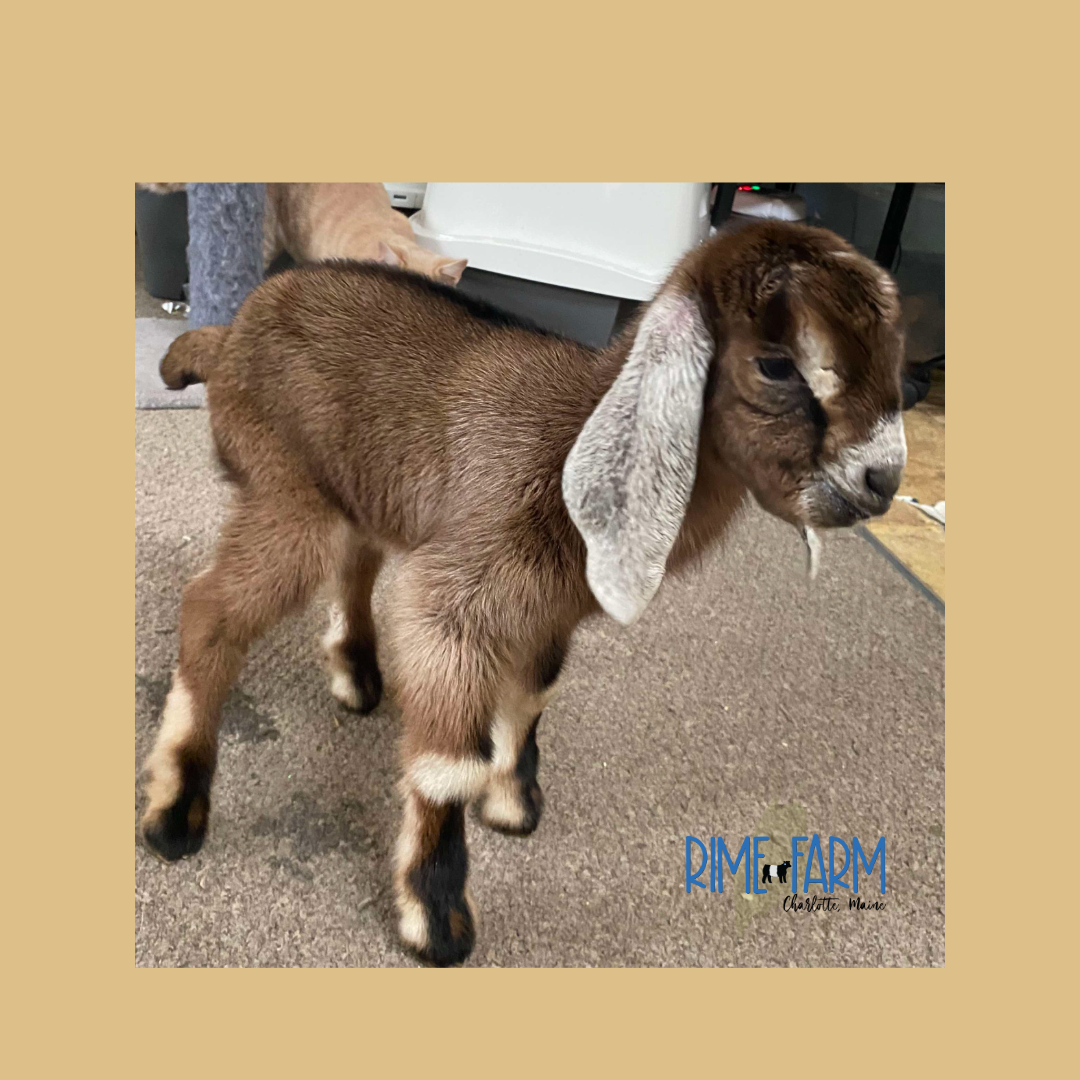
There’s a certain kind of happiness that comes along with goats that I just can’t put down on paper.
It’s not the loud, chaotic kind (although there is plenty of bleating and bouncing to go with). It’s more a quieter, steadier kind. The kind that reminds you something deeply useful has joined your farm. We’ve purchased a new dairy goat doeling*. She’s a long-eared, deep-eyed Nubian doe named Delilah. She hails from from Blue Willow Acres in New Gloucester, Maine, and we’re so excited to have her join us.
Her presence will mark the beginning of a new rhythm here. She’ll see morning milkings one day. But in the meantime, she’ll get to play with our dogs, her doeling herdmates, and me!
Goats are, quite simply, one of the most versatile and valuable animals a small farm or homestead can have.
Why Goats?
Goats are compact, intelligent, and highly adaptable. They are a cool combo f practicality and personality. Goats can provide milk, meat, fiber, land management, companionship—and sometimes all of the above. Delilah is a milking goat. 🙂
They require a lot less space than cattle. They’re easier to manage than many think and you don’t need hundreds of acres. You do need good fencing, a dry shelter, and a commitment for daily care.
The Value of Goat Milk
Goat milk is one of the most digestible and nutrient-rich milks available. It’s easier on the stomach than cow’s milk. It can be used for coffee creamer, cheese, yogurt, kefir, soap-making, and so much more. Nubians are a breed known milk that’s high in butterfat (rich, creamy, and ideal for artisan use).
For the homesteader, having a dairy goat means no longer being dependent on store-bought milk. It’s one more link in the chain of self-sufficiency. We also see it as an assurance that you can feed your family even when supply chains falter. (We think everyone should have a few chickens and a couple of goats. Ha!)
Daily Care is our Connection
Goats thrive on routine. Milking twice a day (at least once, once they’re settled), feeding, cleaning, watching for signs of illness or injury…all of this becomes part of the farm’s daily chores.
But goats are more than a chore. Goats are really present animals. They watch you. They talk to you. They form bonds, they follow you around the pasture, and nuzzle your pockets for treats. Oh my gosh, they’re fun. You’ll find yourself talking to them more than you expect, too You’ll learn their moods and voices. In the end, they become part of the farm and you’ll miss them so much when they’re gone.
Why We Chose a Nubian
For our first foray back to milking, we wanted a breed that would be a good milker with higher butterfat content. Butterfat is the rich, creamy part of the milk that makes for amazing cheese, yogurt, and soap. The higher the butterfat, the more luxurious and dense your dairy products will be (especially those soft cheeses we love).
Nubians typically average around 4.5–5.5% butterfat, which is on the higher end for full-size dairy breeds. That’s what makes their milk so good for homesteaders looking to make more than just a glass of milk. You can actually send milk samples to a lab for precise butterfat testing (many goat owners do this monthly during lactation to track changes), but you can also get a general feel just by observing the cream line in raw milk.
Nubians are a great balance between quantity and richness. For us, that makes them the right choice. Their milk is rich and their personalities are strong. They’re expressive (some say too expressive) and affectionate. Yes, they do have opinions, loudly voiced.
They’re also know for their roman noses and huge ears.
They have a prominent convex curve along the bridge of the nose. This actually traces back to their rich and diverse genetic heritage. The breed was developed in 19th-century Britain by crossing native English dairy goats with imported stock from the Middle East, North Africa, and India, including Egyptian Zariby and Indian Jamnapari goats. These desert-adapted ancestors commonly had Roman noses and long, pendulous ears. These were traits that were well suited to hot climates and they still show up in the modern Nubian’s look.
Though the Roman nose may have once held adaptive value (aiding in heat dissipation or air temperature regulation through elongated nasal passages) today it’s largely aesthetic. It’s a defining characteristic of the Nubian breed standard. I think it’s a regal profile that sets them apart from other dairy goats. While not directly tied to milk production, the Roman nose is part of what makes the Nubian instantly recognizable, and it continues to be prized in show rings and breeding programs.
The loooong ears, like the nose, are a trait passed down from their desert-dwelling ancestors. Again, it was thought to help with heat regulation by releasing excess body heat. Around here, they mostly catch the wind and make them look like floating poets on the hillside.

Delilah has already stolen our hearts.

We can’t wait to pick her up from the breeder but love the fact that the breeder is taking the extra time and care to make her a super star. Polling, weaning, etc. are all important. Be weary of a breeder who is quick to unload them.
If you’ve ever considered adding a goat or two to your homestead, I’d encourage it. Just remember, that like all farm animals, they require lots of care. If, and when, you decide that goats are right for you, we think you’ll be glad you added them to your farmstead. They give back so much in return for their care–milk, laughter, land management. We’ll be sure to cover that aspect in a future post.
It’s why we do this work…to live closer to the land, to nourish what nourishes us, and to welcome creatures that help us do both.
Meet Delilah!
Photos courtesy of Blue Willow Acres.

You can reach out to Blue Willow Acres here.
Here are some handy-dandy goat terms, too.
A doeling is a young female goat (typically under one year of age) who hasn’t been bred or freshened (i.e., given birth and begun producing milk). The term is used a lot like how heifer refers to a young female cow who hasn’t calved yet.
In general goat-keeping terms:
- A kid is any baby goat, male or female.
- A doeling is a young female kid.
- A buckling is a young male kid.
- Once a doeling has her first kidding, she becomes a doe.
Delilah is a delightful doeling. (Say that 3 times fast.)




Leave a Reply