
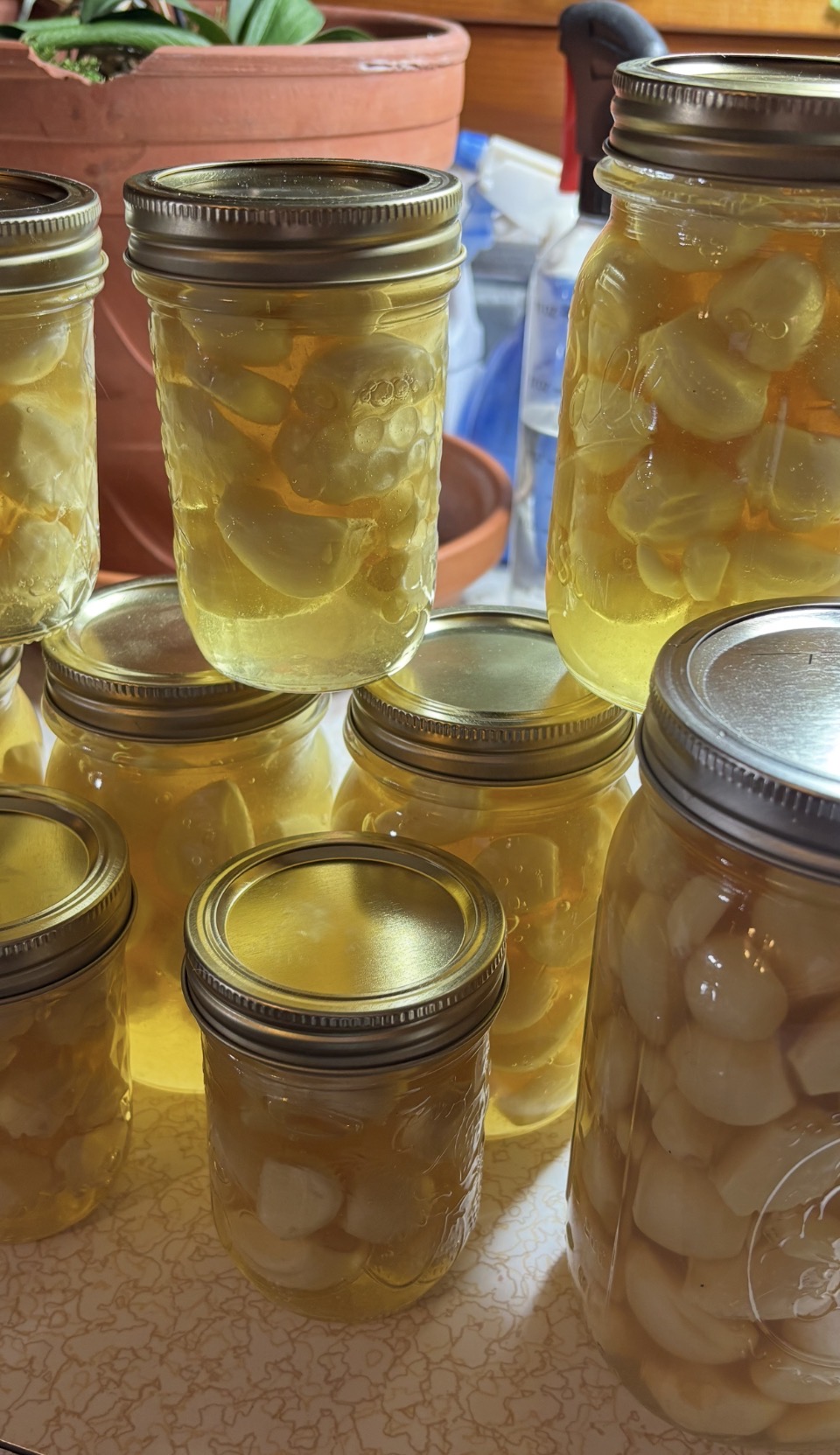
There is something super satisfying about a row of Mason jars filled with something you’ve made yourself!
This week, I found myself peeling a ton of garlic alongside Mom. Lots and lots of garlic. By the time we finished, we had ten jars of beautiful golden honey and fresh garlic cloves, all tucked away in the refrigerator, waiting for the flavors to develop.
If you’ve ever peeled enough garlic to fill ten jars, you know it’s not exactly a five-minute project. Ha. My hands still smell. But that’s part of what I love about putting food by. There’s a sense of accomplishment when you’re done.
My latest project is honey garlic. It’s a wonderfully simple preparation made with just two ingredients.
What Is Honey Garlic?
Honey garlic is exactly what it sounds like. Fresh garlic from our garden submerged in raw honey.
We grow a few varieties of garlic here at Rime Nor Reason Farm. This particular variety is Red Russian. It’s a beautiful hardneck garlic that we save from year to year for replanting. There’s something especially satisfying about using garlic that began as a few cloves planted in our own soil.
The raw honey came from a cute little Amish stand up in Aroostook County, Maine, that I absolutely love.
Honey garlic is often called fermented honey garlic, although there’s a distinction between garlic that’s actually fermenting and garlic that’s simply infusing in honey.
Traditional fermented honey garlic is often made by leaving garlic submerged in honey at room temperature, sometimes for weeks. As the garlic releases moisture, the honey thins and fermentation may begin.
It’s a fascinating process, but there’s a little food science worth understanding. Garlic is a low-acid food, and adding its moisture to honey changes the conditions that normally make honey so resistant to spoilage. Without a validated fermentation process, there’s a potential risk of botulism.
I’ve seen plenty of honey garlic recipes circulating on TikTok, and while I love traditional food preparation, I’m also a big believer in understanding what we’re doing and why. So, I’m taking the refrigerated route with mine and freezing what we won’t use right away. It’s a simple precaution that makes sense to me.
That makes my preparation more of a refrigerated garlic-infused honey than a traditional room-temperature ferment.
That’s A-OK with me. I’m doing it for the flavor and to add to recipes. I also have a pretty good understanding of the science behind what we’re making.
Just Two Ingredients
One of the nicest things about honey garlic is how little you need.
Ingredients:
- Fresh garlic cloves
- Honey, preferably raw
Equipment:
- Clean, dry Mason jars
- Lids
- A little patience!
I used whole, peeled garlic cloves and enough honey to cover them completely.
Raw honey, in my opinion, has better flavor than regular honey. I also love the minimal processing. Raw honey doesn’t automatically make this safer or guarantee fermentation, so you can use whatever you have, raw or regular.
How to Make Honey Garlic
1. Peel the garlic.
Start with fresh, firm garlic bulbs. Separate the cloves and remove their papery skins. Discard any cloves that are soft, moldy, or damaged.
This was ridiculously tedious, so if anyone has tips for peeling garlic, I’d really welcome them!
We tried soaking the cloves for about 15 minutes in water, and I do think that helped with the stickiness. Just be sure to dry them thoroughly afterward.
I left my cloves whole. Some recipes suggest crushing or slicing them, but I like the appearance of whole cloves suspended in honey.
So pretty.
2. Fill the jars.
Place the peeled cloves into clean, completely dry Mason jars, leaving some room at the top.
I ran my jars through the dishwasher’s sanitizing cycle first.
There’s no need to pack the garlic tightly. You want enough space for the honey to flow around the cloves.
I left approximately 1 to 1½ inches of headspace.
3. Add the honey.
Slowly pour honey over the cloves until they’re completely covered.
Be sure to give it a little time to settle between the garlic cloves. You may see air bubbles rising through the jars as the honey fills those spaces.
I also gently turn the jars a few times to help the honey move around the garlic and make sure everything is coated.
The honey is thick, so this takes a little patience.
4. Cover and refrigerate.
Secure the lids and place the jars directly into a refrigerator maintained at 40°F or below.
That’s exactly what I did with my ten jars.

A quick food-safety note: Fresh garlic in honey is not a tested shelf-stable preservation method. Even refrigerated, it should be treated as a short-term preparation. A conservative approach is to use it within four days of making it or freeze it promptly for longer storage. Refrigeration slows microbial growth, but it doesn’t make the mixture safe indefinitely. If you want a true, long-fermented honey garlic, use a scientifically validated process rather than relying on room-temperature storage alone.
A Little Science Behind the Honey
One of the things I find super fascinating is that even simple recipes involve chemistry and microbiology.
Honey naturally contains a high concentration of sugars and very little available water. That low water availability is one reason honey itself can remain stable for such a long time.
Garlic, on the flip side, contains quite a bit of moisture.
When garlic is submerged in honey, water gradually moves out of the garlic and into the surrounding honey. Over time, this can thin the honey and change its consistency.
The garlic also releases flavor compounds into the honey, while the honey contributes sweetness to the garlic.
The result is this cool fusion of two ingredients.
Under certain conditions, microorganisms may begin fermenting the mixture. But whether fermentation occurs, and whether that fermentation is safe, depends on a lot. Acidity, water activity, temperature, and microbial activity all play a role.
There’s an entire world of science happening inside something as simple as a Mason jar each time we do something like this.
Health Benefits?
Garlic and honey have been used in folk remedies for centuries.
Garlic contains sulfur compounds, including substances formed when garlic is crushed or chopped. Honey contains sugars, organic acids, and a variety of other naturally occurring compounds.
Both have been studied for their biological properties.
That said, I’m always a little leery of claims.
There’s not enough clinical evidence to say definitively that homemade honey garlic prevents illness, strengthens immunity, or treats infections.
Do I think certain traditional remedies have value? Absolutely. But my scientific mind says proof is what allows us to make claims.
I love, love, love making old-school remedies, but I think we do ourselves a disservice when we turn every food into a miracle cure. Sometimes good food can simply be good food.
How Do You Use Honey Garlic?
This is where the possibilities get interesting! The combo of honey and garlic lends itself to all sorts of dishes.
A few recipes I’m looking forward to making:
- Roasted pork: Honey, garlic, mustard, and a little apple cider vinegar. This makes a wonderful glaze for our farm-raised pork.
- Roasted vegetables: A little garlic-infused honey over carrots, Brussels sprouts, or winter squash. YUM.
- Homemade salad dressing: Whisked with olive oil, apple cider vinegar, and a pinch of salt.
- Chicken: Brushed over roasted or grilled chicken during the final minutes of cooking.
- Bread: Softened garlic mashed onto warm, crusty bread.
- Marinades: Combined with herbs, vinegar, and spices for a sweet-savory marinade.
I’m really looking forward to experimenting with the garlic and honey in pork recipes. We raise our own pastured pork, and I can already imagine how good this would be with a slow-roasted pork shoulder.
Preserving Food Is About More Than Filling Jars
I’ve always been drawn to growing, preparing, and preserving food.
Part of that comes from my childhood with my great-grandmother, grandmother, and mother. They canned and jarred so much. I grew up around women who understood the importance of putting food by, making use of what was available, and wasting as little as possible.
Part of it comes from wanting to understand how people fed themselves and their families long before grocery stores and modern conveniences became central to daily life.
And the last part comes from living on a farm.
I don’t want anything to go to waste.
But preserving food also means understanding why certain methods work.
Not everything our grandparents did was necessarily safe, and not every popular recipe circulating online has been tested for long-term storage.
I don’t like unnecessary risk.
I think we can appreciate the ingenuity of earlier generations while still adhering to modern food-safety advice.
To me, tradition and science aren’t competing ideas. They complement one another.
And honestly, learning the why behind these things makes the whole process even more interesting.
Ten Jars, Two Ingredients, and Another Kitchen Experiment
So here we are. Ten jars of garlic and honey, a kitchen that smelled like garlic, hands that STILL smell like garlic, and another little adventure in the Rime Farm kitchen.
I think one of the nicest things about growing our own food is finding new ways to enjoy what we’ve harvested.
This particular garlic started in our soil, came out of the garden, and eventually found its way into jars alongside some beautiful Maine honey.
Nothing particularly fancy. Just good ingredients and a little time spent in the kitchen with Mom.
And that’s really what I love about this life.
Food doesn’t have to be complicated to be interesting. Sometimes all it takes is a handful of garlic cloves, a jar of honey, and a little curiosity.
Now, if anyone has a brilliant trick for peeling ten jars’ worth of garlic, I’m all ears. Ha!




Leave a Reply